
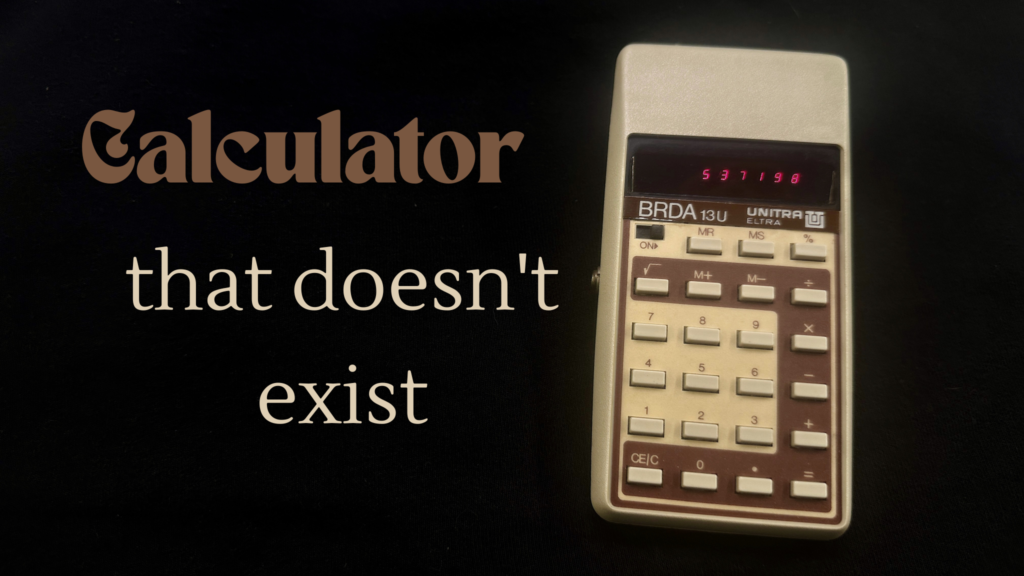
When searching the internet for information about the Brda 13U calculator, you may come across comments claiming that such a device never existed. This is a rather strange opinion, since it’s not that difficult to find photos of this calculator. Of course, there aren’t many of them, since the device itself was produced in fairly limited quantities, but this clearly indicates that the Unitra Brda 13U was a real piece of equipment created during the communist era in Poland.
As it happens, I managed to buy one of these forgotten calculating machines a while back, so I’ll be able to tell you a little more about its inner workings and history right here in this article.
Calculators from Bydgoszcz
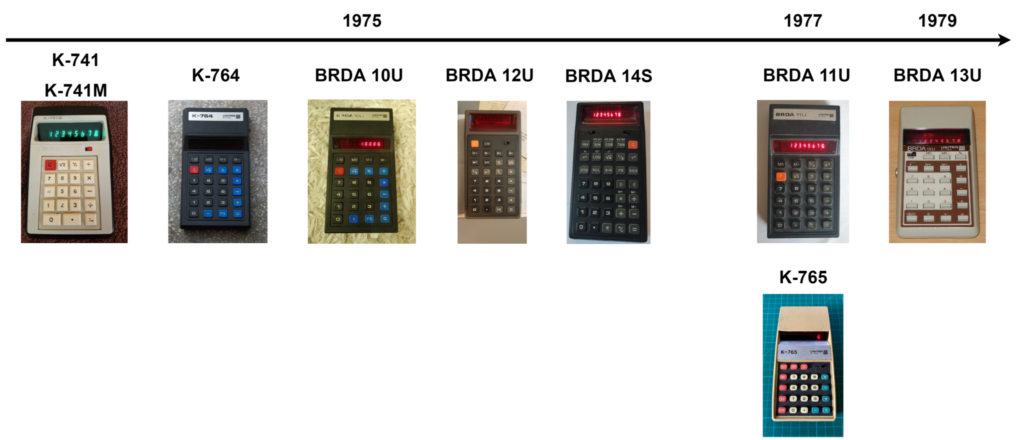
The Unitra plant in Bydgoszcz was established in 1923, although at that time it was not yet formally known as Unitra. Until the mid-1970s, the company specialized in the production of radio receivers, but at some point, a party official decided that calculators should be manufactured in Poland. Elwro in Wrocław took on the production of desktop models, while Eltra in Bydgoszcz was tasked with producing pocket calculators. It all began with a model codenamed K-741 and its successor, the K-741M, which featured a slightly modified keyboard layout. These calculators were Japanese designs based on VFD displays and adapted for the Polish market. Later that same year, another device appeared—the K-764, which was later renamed the Brda 10U—thus marking the beginning of a rather iconic series of calculators that took their name from the river flowing through Bydgoszcz.
The Brda 10U, 12U, and 14S together form a very successful family of pocket calculators. Here we have a basic model, a slightly more advanced one, and a typical scientific model. These calculators were produced until 1977, when the Brda 10U was replaced by the 11U model, gaining a few useful features in the process. That same year also saw the release of the K-765, whose intended purpose remains a mystery, but evidence suggests it may have been an attempt to launch a new series of pocket calculators.
Two years later, post-war Poland saw the release of a device described as the Brda 13U. The decision to develop this calculator strikes me as a bit odd; its name suggests that the device was meant to be something between the 12U and 14S models, which is quite confusing. Both devices are significantly more complex than the model we’re discussing today and, moreover, offer more advanced mathematical functions. The 13U isn’t some kind of experiment either, since such devices among the calculating machines from Bydgoszcz were designated with the letter “K,” so it’s quite difficult to determine what this calculator was supposed to be. Perhaps it was simply an attempt to refresh the series and introduce new devices to the market—an effort that ultimately never came to fruition.
A beige Bakelite relic from the past
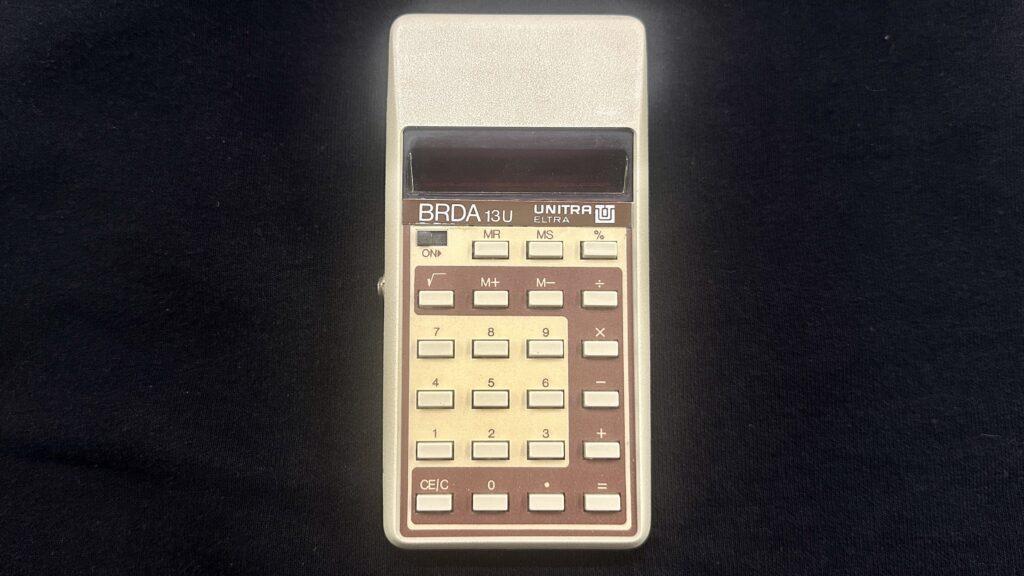
Looking at the 13U model in all its glory, we can see the fairly classic design of calculators from those years. The calculator is small, and its beige casing consists of two parts. On the front, there are small, fairly high-quality buttons with a short travel, surrounded by plastic labels indicating their functions; interestingly, the function keys here are also a shade of bakelite brown. The front panel also features a switch to turn the calculator on. It’s worth noting that there’s also a connector for an external power supply on the left side of the casing.
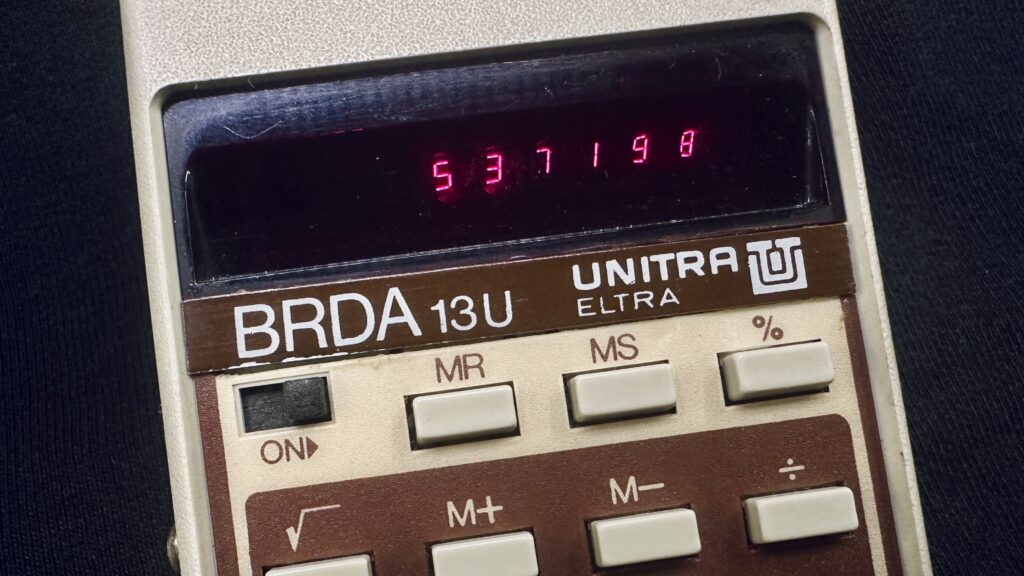
Above the keyboard is a thin, brown-painted plate that also features the model number and the Unitra Eltra logo. The final element of the front panel is a semi-transparent red plastic panel, beneath which the display is hidden. It is a small 9-digit LED display, a design that was quite common at the time.
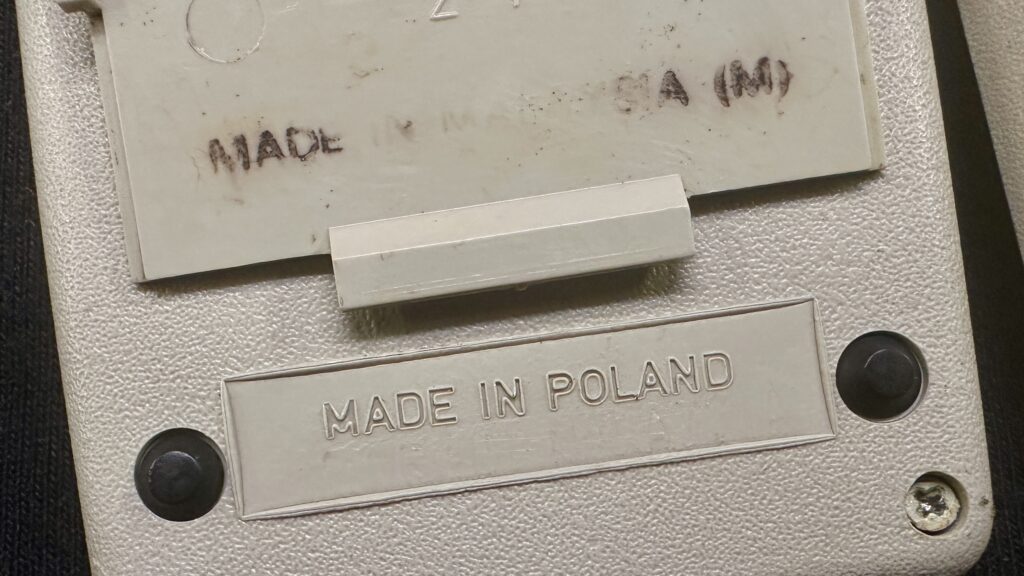
On the bottom of the device is a flap that conceals a compartment for a 9V battery and a small area presumably intended for a nameplate, where the proud inscription “MADE IN POLAND” is displayed. The charm, however, fades when you open the battery cover, because on the underside there is a partially worn-away inscription reading “MADE IN MALAYSIA (M).” This immediately reveals that this calculator has little to do with Poland; in our country, they likely only affixed the label visible on the front and stamped the text on the bottom of the device.
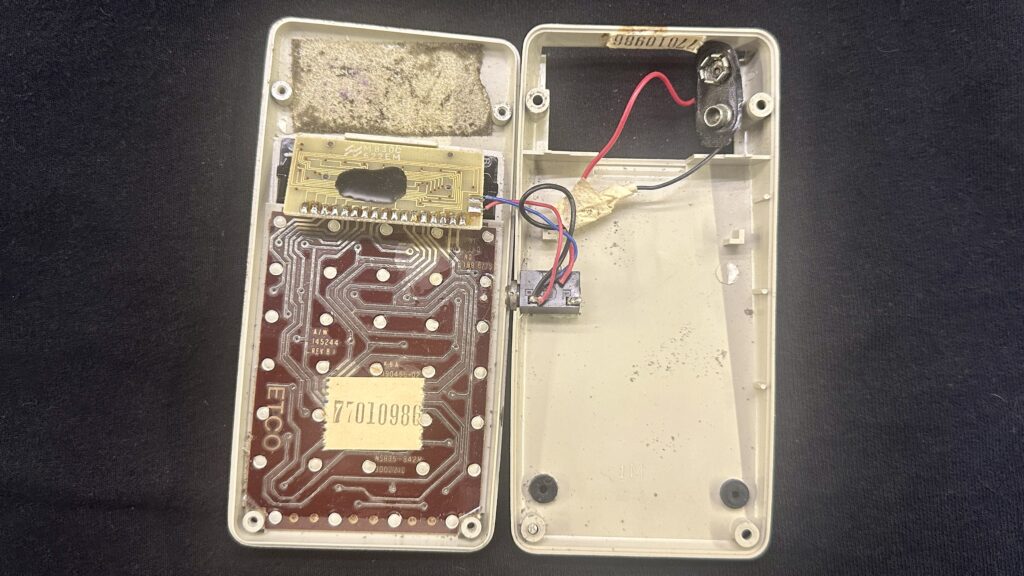
To access the inside of the device, simply unscrew the four screws, and the case will split into two parts. Here, you can clearly see where the battery should be located, as well as the external display connector on the edge. In addition, we can see the keyboard laminate and the display board with the device’s integrated processor, which looks strangely familiar.
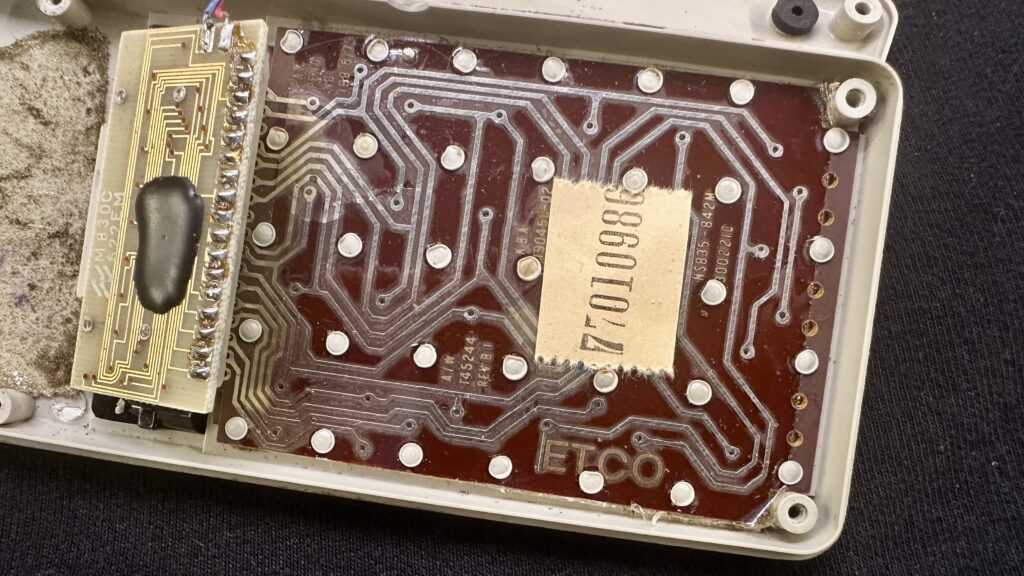
The calculator’s keypad is attached to the rest of the casing with plastic rivets, which is a rather unfortunate and one-time solution, since reassembling the device may be difficult whenever it breaks down. In addition, the laminate features several etched markings and a paper label, which I suspect may be a creative touch by Eltra.
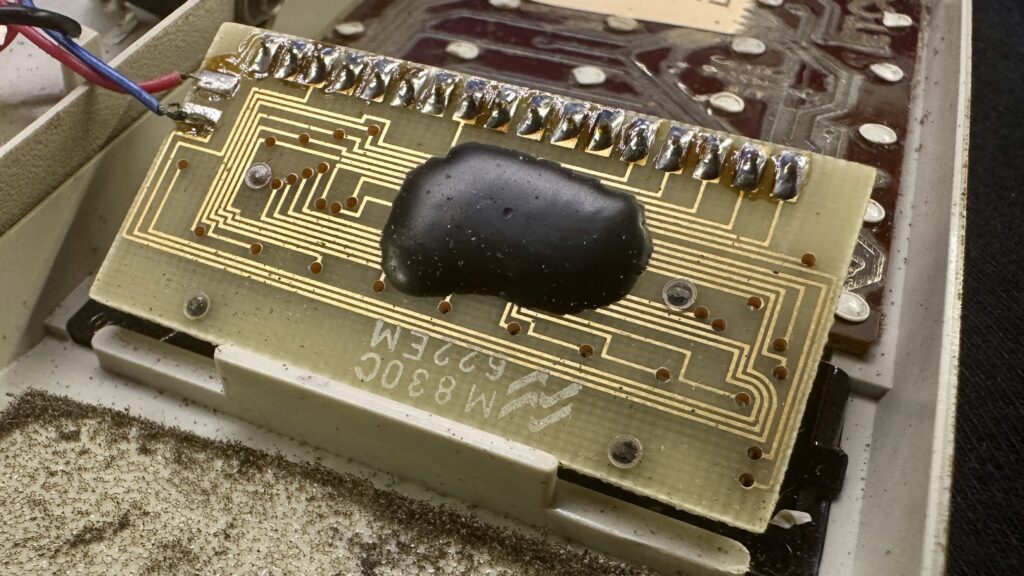
Looking at the device’s “brain,” we can see a certain modernity here: a single—or, as I suspect, dual—silicon core is hidden beneath black plastic, reminiscent of contemporary designs from the Far East. Here, however, this device comes from the United States—more specifically, from National Semiconductor, whose logo is visible right next to the M830C marking. The entire unit is integrated with a display located on the other side.
When I first looked inside the Brda 13U, the circuit board came as quite a surprise to me, especially since I had previously analyzed a very similar design, which I initially thought was just a display but ultimately turned out to be a calculator. It differed slightly in its markings, but the physical traces suggest that it is practically the same, though there is no certainty regarding its functionality. Perhaps I already had a part of that calculator in my hands back then, though it could have come from a foreign design. Here, too, we can touch on the “Polishness” of this calculator. As I mentioned earlier, in our country they likely only added the label; in reality, this device operated under the name National Semiconductor 835. Perhaps later plans called for replacing foreign components with something produced in one of the socialist countries, just as had already been done with other calculators. Ultimately, however, due to the small production run and economic difficulties, we were never able to find out what the plans of the officials at Unitra Eltra were.
If anyone is interested in the inner workings of this calculator, I refer you to one of my earlier articles.
