

Anyone studying electronics knows that semiconductor diodes can be divided into several categories: classic rectifier diodes, light-emitting LEDs, fast Schottky diodes, and Zener diodes. Although each of these components is based on the same phenomenon occurring in the simplest structure of a semiconductor PN junction, a closer look reveals that there are quite a few differences. Thanks to these differences—which are numerous enough to warrant a separate article—each type of diode is used in a slightly different application. When designing a power supply, it would be an aberration to use LEDs as a rectifier bridge (though it would be an interesting experiment), and similarly, when building a device requiring color indicators, no one would use rectifier diodes for that purpose—but are we really sure?
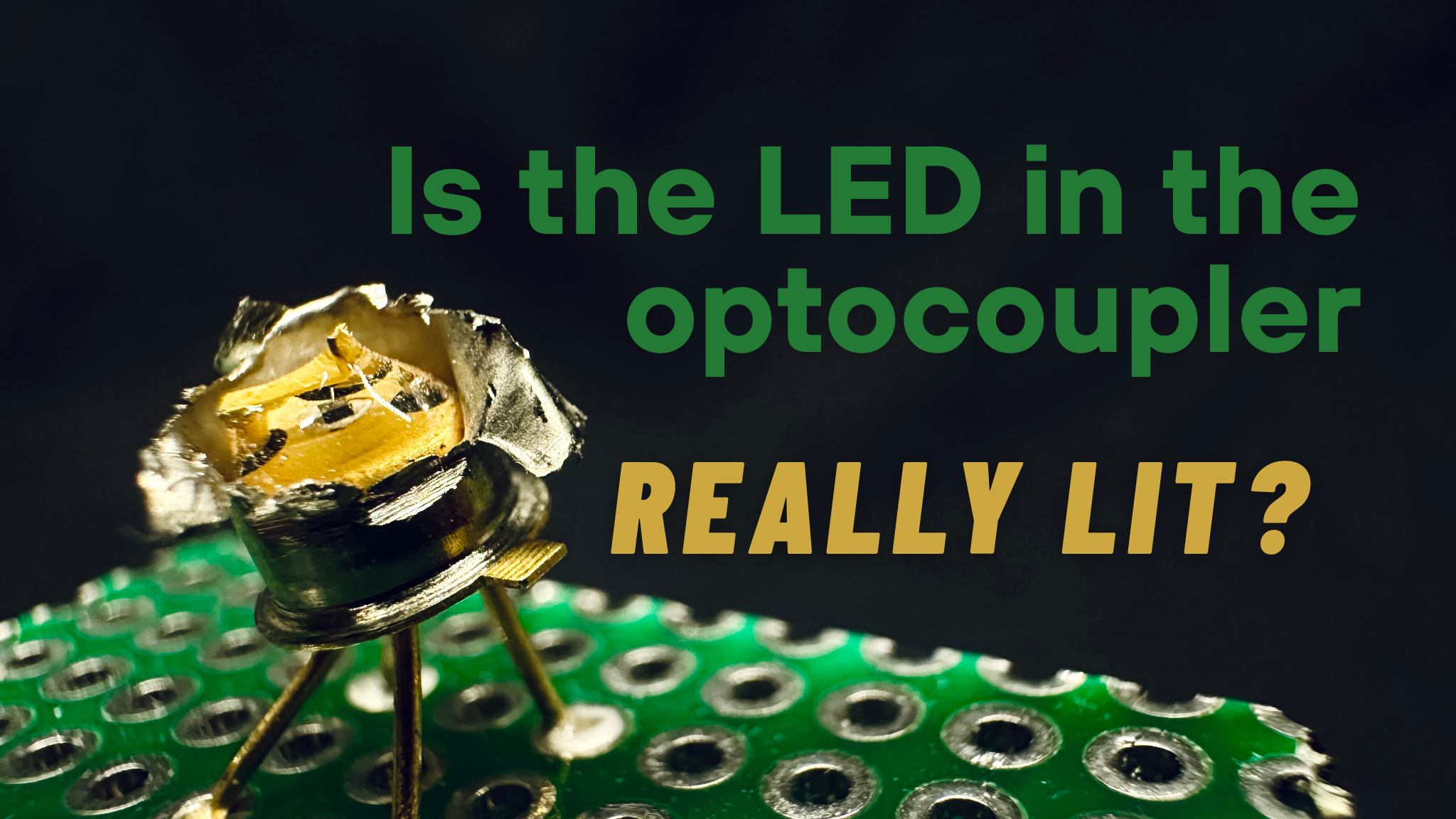
This article is a sort of follow-up to the piece on exploring the light inside a transoptor; if you’re curious to know whether the LEDs placed inside it actually glow, I encourage you to read it.
Why do LEDs glow?

But first, let’s ask ourselves a simple question: why do LEDs glow? In a nutshell, one could say that light emission is actually the result of energy loss. Each LED is, in fact, a structure composed of P-type and N-type semiconductors. Both of these silicon regions are doped with other elements to create structures with a surplus of free electrons—the N-type—and, in the other case, a deficiency of electrons—the P-type. In the latter case, we also speak of a greater number of so-called electron holes, interpreted as positive carriers of electric charge.
If a diode is not biased by a specific voltage, not much will happen inside it, but that does not mean that no processes are taking place there. At the junction of the two types of semiconductor, excess electrons jump into the vacant sites that dominate in P-type silicon. This transition is called recombination, and its effect is the creation of an area virtually devoid of any free charge carriers, accompanied by a small electric field that inhibits the further movement of the remaining electrons. In other words, it can be said that a small number of negative charge carriers accumulated at the interface between the different doped regions will jump to the other side, and the resulting electric field will block the further movement of more distant electrons.
For them to move, energy is required—for example, an electric voltage. If we polarize the LED in the forward direction, we will cause the naturally generated electric field to be too weak to block the electrons, and these electrons, jumping across the barrier layer, will recombine with holes located farther and farther away in the P-type semiconductor. Thus, an electric current will flow through the component, and we will see light.

This is the result of the recombination process. Electrons, which we generally interpret as electric current, can perform a dual function in a diode. Some of them form bonds between individual silicon atoms and the impurities artificially added to the silicon. These electrons are said to be in the valence band. On the other hand, there are also quite a few free electrons that can move between atoms; we refer to these as being in the conduction band. When a negative charge undergoes recombination—that is, jumps across the semiconductor’s barrier layer from the N-type region to the P-type region—it very often also transitions from the conduction band to the valence band. Electrons in the conduction band have higher energy than those in the valence band, and since everything in nature strives for equilibrium, the recombining electron must do something with its excess energy.
This energy is emitted in the form of a photon, resulting in light visible to the human eye. However, it is important to note that not all recombining electrons emit light. There are also so-called non-radiative processes, in which excess energy is converted into a kind of vibration of the semiconductor’s crystal lattice, and consequently into heat. That is why no LED has 100% efficiency, and so-called power devices must always be accompanied by a heat sink to dissipate the excess energy.
The color of the light emitted by an LED depends on the amount of energy carried by the emitted photon. This, in turn, reflects the size of the energy gap between the conduction band and the valence band. The smaller this gap, the less energy the photons will have, which we interpret as a color close to red. On the other hand, a large energy gap will result in the emission of blue or ultraviolet light. When designing LEDs, engineers strive to achieve a specific photon energy value by manipulating the types and quantities of semiconductor material, thereby obtaining a specific LED color.
Can a rectifier diode emit photons?

So how does a classic rectifier diode work? The answer may be a bit counterintuitive, but it works exactly the same way as a light-emitting diode. The only difference here is the intended outcome. In an LED, we aim to have as many recombining electrons as possible emit photons, whereas here that doesn’t matter at all. Rectifier diodes are designed to rectify voltage as effectively as possible, but that doesn’t mean they don’t emit light. On the contrary, every rectifier diode actually glows, just a little differently than it might seem.
In rectifier diodes, electrons crossing the barrier layer are mostly subject to non-radiative processes, which means that these components generate more heat than light. However, photons are also produced here, though their number is several orders of magnitude lower than in light-emitting diodes. Furthermore, components designed to rectify voltage use materials that result in a relatively narrow energy bandwidth, meaning the expected photon energy is also quite low. Rectifier diodes emit light in the far-infrared range, which is why we cannot see this light with the naked eye. Furthermore, none of the common methods for viewing infrared light will be effective here, but more on that later in this article.

As three representatives of the rectifier diode category whose inner workings I will attempt to reveal, I chose the classic small 1N5404 diode and two slightly larger Soviet components, the МД217 and Д226Д. Opening up components from a country that proudly overcame the problems it created for itself was relatively simple. All it took was a mini grinder and a bit of patience. The interior revealed a silicon core glued to one of the diode’s walls, along with a second lead attached to it. Peering inside the 1N5404 seemed a bit more difficult, but all I had to do was place the component in a vise and squeeze it lightly. As a result of the external force, the diode’s casing cracked, revealing two metal plates with a silicon core sandwiched between them.
How can you see light that isn't visible?

As I mentioned, it’s impossible to see the infrared light from a rectifier LED with the naked eye. What’s more, due to the design of such an LED, the wavelength is expected to be over 1200 nm, which means we won’t even be able to see it through a smartphone camera lens—one of the first methods for detecting IR light that might come to mind. This method works for a TV remote control, but keep in mind that the purpose of the LED used there is specifically to emit infrared light. In the case of rectifier components, it is “incidental” far-infrared light with a much longer wavelength.
The easiest way to see this unique type of light is to use a camera with the IR filter removed. In my experiments, I decided to use one of my dedicated Raspberry Pi modules. After opening the case, you can see the image sensor, which has an infrared filter on it. Removing it is relatively simple, but you have to be careful not to accidentally damage other components. Once the camera is prepared in this way, simply place it next to the rectifier diode, start the live view, and apply power so that a small current flows through the diode.
This is what the first experiment with a 1N5404 diode looks like. As you can see, the pulsed voltage causes the diode to glow. This is nothing more than the aforementioned recombination process, in which electrons jump from the conduction band to the valence band, resulting in the emission of light.
In the case of the D226D diode, the structure of the core itself is quite clearly visible, as is the circular area around the metal electrode. Here, too, the voltage is applied in pulses, and the diode emits infrared light.
In the last rectifier diode, the core is sandwiched between two covers of different diameters, so that only the outer surface of the silicon is visible; as in the previous cases, this surface also glows.
As you can see, semiconductors can emit light, and their name doesn’t necessarily have to include the term “electroluminescent.” Of course, treating a rectifier diode as an infrared source doesn’t make much sense, but it is an interesting fact that although these diodes are not designed to emit light, due to their structure and similarity to ordinary LEDs, such components can also emit photons. What’s more, other semiconductor components can also emit light—ones from which no one would expect it—and what’s more, this light will fall within the visible spectrum, but that is a topic for another article.

